
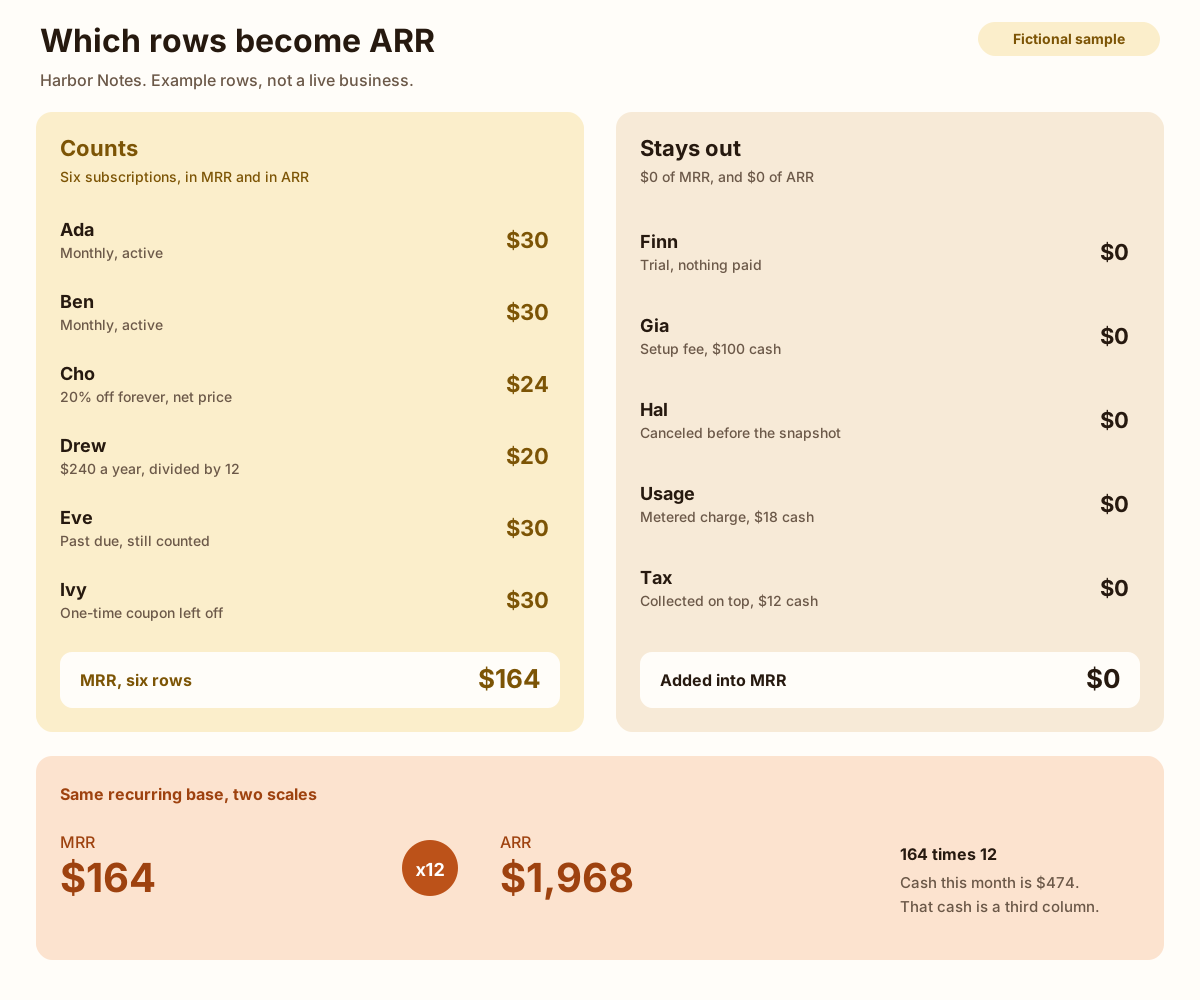
The same subscriptions, written as one month or as a year. A fictional product shows which rows survive the conversion.
On this page
The short answer
MRR is recurring revenue normalized to one month. ARR is that same recurring base times 12. Neither number is the cash you collected, and neither number is bookings. On the Harbor Notes sample, which is a fictional product, MRR is $164 and ARR is $1,968.
What is the difference between MRR and ARR
MRR is the subscriptions you still have, rewritten as one month. ARR is that monthly recurring base written as a year. On this worksheet, ARR is MRR times 12.
Cash is a third number. It is what arrived in the sample month. A booking, as this sheet uses the word, is the value of a charge or a signed fee, including a fee that will not happen again. The $100 setup fee in the sample is a booking and it is cash. It is not MRR, and it is not ARR.
How does ACV vs ARR differ from MRR vs ARR
Stripe’s ACV page, updated January 21, 2026, says annual contract value is how much revenue a single customer contract generates in a year. Divide that contract’s recurring value by the number of years it covers. One-time charges typically stay out. The same page says ACV is one customer at a time, and ARR is the recurring revenue expected in a year from all customers combined. On the Harbor Notes sample, Drew’s $240 annual plan has an ACV of $240. The sample ARR is $1,968, the recurring base across the rows that count, not Drew’s ACV. Gia’s $100 setup fee stays out of both.
A second Stripe page, ACV vs ARR, updated May 12, 2025, defines ACV as an average. Add the yearly contract values and divide by the number of customers. Their example is $60,000 plus $40,000, divided by 2, which is $50,000. This worksheet does not average the Harbor Notes rows. Paddle’s ACV page divides total contract value, excluding one-time fees, by the years in the contract. A five-year contract for $50,000 is an ACV of $10,000 on that page. Drew’s $240 is the per-contract division for a one-year plan.
| Question | MRR | ARR | ACV |
|---|---|---|---|
| Unit of time | One month | One year | One year of one contract |
| What it includes | Recurring revenue, normalized to a month. A setup fee, metered usage, and tax stay out on this sheet. | That same recurring base. Not cash, and not a one-off fee. | The recurring value of that one contract. One-time charges stay out. |
| Best for | Monthly plans, and the month in front of you | The yearly recurring total, including an annual plan written as a year | Comparing one contract with another, whatever the term |
| How to convert | A yearly price divided by 12 | On this sheet, the MRR total times 12 | Recurring contract value divided by the years it covers. Drew’s $240 plan is an ACV of $240. |
| Question | MRR | ARR |
|---|---|---|
| What it measures | Recurring revenue for one month | That same recurring base for a year |
| How this sheet converts | A yearly price divided by 12 | The MRR total times 12 |
| Annual plan of $240 | $20 every month of the term | $240 |
| Setup fee | Out | Out |
| Cash collected | Its own column | Its own column |
The hand rules for building the monthly number, on a different fictional ledger, are in How to calculate MRR. This page is the step from that monthly number to the yearly label, and the places the billing pages do not use one sentence for both.
How do you convert MRR to ARR
Two directions. Both are arithmetic.
A monthly price stays as it is inside MRR. Multiply the finished MRR total by 12 to get ARR. An annual price goes in the other way. Divide it by 12, and count that twelfth in every month of the term, including months when the card is not charged. Multiply that twelfth by 12 and you are back at the yearly price.
Stripe Billing analytics defines MRR as the monthly-normalized value of active and past_due subscriptions. Their own example on that page is 100 subscribers at $100 a month and 50 at $600 a year. They calculate that as $12,500. Those are Stripe’s figures. The division by 12 is in the example. How to calculate MRR walks the same rule with a worksheet.
Stripe also publishes ARR. The supported metrics page lists revenue.mrr as monthly recurring revenue from active and past-due subscriptions, and revenue.arr as annual recurring revenue from active and past-due subscriptions. The Analytics API says you can query the two together, because they share a namespace. None of those three pages states that ARR equals MRR times 12. The times 12 on this worksheet is arithmetic. It is not a sentence from Stripe. If you export both metrics, check whether your account’s ARR is 12 times its MRR before you treat them as the same base.
Paddle’s help center converts every billing cycle into a month. A monthly plan uses the value charged. An annual plan divides the invoice by the plan length, then divides by 12. A weekly plan divides by the plan length and multiplies by 4.33. A daily plan divides by the plan length and multiplies by 30. This sample has no weekly plan and no daily plan. For a one-year plan priced at $240, reading the plan length as 1 year, that annual rule is 240 divided by 1 divided by 12, which is $20 of MRR.
Paddle’s recurring revenue page says ARR is your MRR multiplied by 12. Paddle’s ARR page says ARR is the annualized version of MRR, and then prints a second formula. That formula adds subscription revenue for the year and recurring upgrades, then subtracts cancellations and downgrades that year. The same page says another way is to multiply MRR by 12.
Those two readings are not the same number. The page walks its year-sum formula with prices it prints for a Netflix example. This post did not recheck Netflix. The prices below are the ones on Paddle’s page, checked October 31, 2026. A customer starts at $8.99 a month, upgrades by $7 to $15.99 after three months, and does not cancel. Paddle adds $8.99 times 12 ($107.88) to $7 times the remaining 9 months ($63) and calls the result $170.88. Three months at $8.99 plus nine months at $15.99 is the same $170.88. The ending price times 12 is $15.99 times 12, which is $191.88. The page also multiplies the three-month case by 50 and prints $8,544, and the six-month upgrade case ($149.88 a customer) by 50 and prints $7,494. 50 times 170.88 is 8,544. 50 times 149.88 is 7,494. The year-sum and the ending run rate still disagree for one customer, by $21.00.
Use the times-12 reading when you mean the recurring base you have now, annualized. Use a year-sum only when you mean what those subscriptions added up to across a calendar year, and label it as that. This worksheet’s ARR is the times-12 reading.
Lemon Squeezy’s May 2025 post announces updated MRR charts and updated ARR charts. It says percentage discounts that apply forever are subtracted for both. It does not state that ARR is MRR times 12. The customer object has mrr as an integer number of cents, in USD. The example on that page is mrr 1999, shown as $19.99. That 1999 is the shape of the field, not a customer of ours. The attributes on that page do not include an arr field.
What counts toward MRR and ARR
Count a row in MRR when it is recurring revenue you still expect, normalized to one month. The ARR column on this sheet is that monthly amount times 12, including a zero. A row that is out of MRR is out of ARR.
Stripe’s definition is the tightest written rule of the three, so the worksheet follows it when the other pages are silent. The list below says where Lemon Squeezy or Paddle prints something else.
Active monthly price. It counts at the price you expect to collect again. Stripe sums the monthly-normalized value of active subscriptions.
Annual plan. Divide by 12. Stripe’s example does this. Paddle’s help center does this for an annual charge, by dividing the invoice by the plan length and then by 12. Lemon Squeezy’s May 2025 post says the charts cover different billing intervals. It does not print the division. The worksheet still divides by 12.
Repeating discount. Use the net price. Stripe always subtracts permanent recurring discounts. Two switches can also subtract other recurring discounts and one-time discounts. Stripe calls subtracting them the more conservative reading. Lemon Squeezy subtracts percentage discounts that apply forever, whether the discount is the whole price or part of it, and draws a second line with those discounts put back. Paddle’s help center ignores a one-time coupon and uses the underlying price. A discount that repeats is factored in.
One-time coupon. Paddle uses the underlying price, so the coupon does not change MRR. Stripe subtracts it only when the one-time discount switch is on. Lemon Squeezy’s post says they subtract recurring discounts that apply forever. It does not say what a coupon on a single invoice does.
Past due. Stripe includes past_due subscriptions in MRR, and drops them when the subscription is canceled or marked unpaid. Stripe’s revenue.arr metric is described with the same active and past-due set. The Paddle help pages and the Lemon Squeezy post checked here do not name a past-due status. The worksheet keeps the past-due row, and that choice is Stripe’s sentence, not a quote from the other two.
Trial. Leave it out until the paid period starts. On Stripe, an item-level trial comes out item by item, and a trial set with trial_end takes the whole subscription out. Paddle’s help center does not count free trials. Lemon Squeezy says stores that mix trials and active subscriptions are one of the cases the new chart was built for. That post does not say the trial itself is valued at zero. The worksheet’s zero is Stripe’s rule and Paddle’s rule.
Setup fee and other one-off charges. Leave them out. Paddle’s help center does not consider one-time payments. Paddle’s ARR page lists set-up fees, credit adjustments, non-recurring add-ons, and one-time charges among the items to exclude from ARR. Paddle’s metrics API says the MRR total does not include one-time payments. Stripe’s MRR is a sum of subscriptions. A setup fee is not one. Lemon Squeezy’s May 2025 post does not mention setup fees. Leaving them out is this worksheet’s rule, tied to Stripe and Paddle.
Metered usage. Stripe excludes metered products from MRR. Usage revenue is a separate metric on that page. Paddle’s help center does not consider metered charges. Lemon Squeezy’s post does not mention usage. The worksheet leaves the usage row out.
Tax. Stripe excludes any tax applied to the subscription. Paddle’s help center says tax and Paddle’s fees are considered in the MRR calculation. It does not say whether the tax dollars are added, subtracted, or handled some other way, so this sheet cannot print a second MRR that “includes the tax.” The worksheet leaves the tax out, which matches Stripe. Check the Paddle screen you actually use before you copy a tax line into MRR.
Canceled. Stripe stops counting a subscription when it is canceled or marked unpaid. Paddle deducts MRR when a customer churns. A churned row is $0 on this sheet. One canceled customer is not a churn rate. The formulas for that rate are in How to calculate churn rate.
Fees. Paddle’s help center says Paddle’s fees are considered. The metrics API says the MRR total does not deduct Paddle fees. The help page does not give a fee amount to subtract, and this sample has no fee row. The worksheet does not invent one. How to calculate MRR keeps the longer note on that split.
A subscription set to cancel later. Lemon Squeezy says MRR now includes a subscription that ends in the future, where the older chart left it out. The same post says this applies to ARR only if the subscription is set to be canceled after the current period, and gives subscriptions with a period of more than one year as the example. A one-year plan that is not set to cancel does not trip that sentence. The sample below has no cancel-later row, so the $164 does not move because of it. If you have a multi-year plan set to cancel at the end of the current period, the MRR chart and the ARR chart can diverge. Read the titles on the chart before you multiply one of them by 12 and expect the other.
Lemon Squeezy also says new stores default to the daily snapshot charts named Monthly Recurring Revenue and Annual Recurring Revenue. Stores already on the older charts may still be on Cumulative MRR and Cumulative ARR, which the post says update in real time. The new charts update daily. Match the title on your chart before you compare it with this sheet.
Should you report MRR or ARR
Quote MRR when the business sells monthly plans and you are looking at this month. A price change, a new subscriber, and a cancellation show up as a dollar change in the month they happen. Paddle’s ARR page says MRR shows how the company grows month by month, and that it is a way to see the immediate effect of a product or pricing change.
Quote ARR when you want that same recurring base as a year. An annual contract is already a yearly price. Dividing it by 12 makes MRR. Multiplying the MRR total by 12 returns the yearly price. Say “ARR, meaning MRR times 12” the first time you hand the number to someone. The Paddle page that also prints a year-sum formula is the reason to say which reading you used.
Paddle’s recurring revenue page says businesses with less than $10 million ARR tend to focus more on calculating MRR. That is their sentence, not a count from this site. A monthly-plan business can live on MRR and still keep ARR beside it as the times-12 figure, so a yearly question has an answer.
ARR is not the same as annual revenue. Paddle’s ARR page says ARR is the annual recurring revenue from subscriptions, while revenue as a general term covers all business income, whether or not it recurs. Stripe’s ACV vs ARR page calls ARR a revenue run rate of current subscriptions, meaning what those subscriptions would bring in over the next 12 months if nothing changed. That is not the GAAP run rate in the next paragraph.
A valuation question can mean a third number. SaaS Capital’s index, which labels its data as of 09/30/26, calls its valuation multiple an ARR multiple. The multiple is market cap divided by annualized current run-rate revenue. They define that run rate as the most recent month of revenue times 12. On the same page, revenue is all reported GAAP revenue, from whatever source, and the month used in the multiple is the most recent quarter divided by three. GAAP revenue can include a setup fee, a service project, or anything else the company reported. It is not subscription MRR times 12 unless the company has nothing else in GAAP revenue. If someone asks for ARR, say whether you are handing them subscription MRR times 12 or annualized GAAP revenue.
What share of a starting cohort you still hold, after expansion and churn, is a different metric. That rate is in How to calculate NRR. More of the money work for a one-person SaaS sits on Money and ops.
A worked example
Harbor Notes is fictional. Ada, Ben, Cho, Drew, Eve, Finn, Gia, Hal, and Ivy are labels, so a row can be checked. They are not real people. Nothing here was measured from a live business. The snapshot date, the last day of an example October, is part of the example too. It is a different sheet from the Lumen Inbox ledger in the MRR guide. Do not add the two together.
The picture is the six rows that count, the five that do not, and the times-12 step. The table under it adds the cash column.
| Line | Status | MRR | ARR | Cash in October |
|---|---|---|---|---|
| Ada, $30 monthly | Active | $30 | $360 | $30 |
| Ben, $30 monthly | Active | $30 | $360 | $30 |
| Cho, $30 monthly, 20% off forever | Active | $24 | $288 | $24 |
| Drew, $240 a year | Active | $20 | $240 | $240 |
| Eve, $30 monthly | Past due | $30 | $360 | $0 |
| Ivy, $30 monthly, $10 coupon once | Active | $30 | $360 | $20 |
| Finn, $30 monthly | Trial | $0 | $0 | $0 |
| Gia, setup fee | One-off | $0 | $0 | $100 |
| Hal, $30 monthly | Canceled | $0 | $0 | $0 |
| Usage meter | Metered | $0 | $0 | $18 |
| Sales tax | Tax | $0 | $0 | $12 |
| Total | Sample | $164 | $1,968 | $474 |
Cho’s discount is 20% of $30, which is $6. The net price is $24. That $24 is the repeating-discount rule. Stripe always removes a permanent recurring discount. Lemon Squeezy subtracts a percentage discount that applies forever. Paddle factors a recurring discount in. All three land on $24 for Cho. ARR for Cho is 24 times 12, which is $288.
Drew’s yearly price divided by 12 is $20 of MRR. ARR for Drew is $240, which is the yearly price back again. The October column assumes the $240 invoice is paid in the example October. That is $240 of cash and $20 of MRR. The gap is the reason to divide by 12.
Eve is past due. The renewal failed and the subscription is still retrying. Stripe still counts it, so the worksheet keeps $30 of MRR and $360 of ARR, with $0 of cash. The Paddle and Lemon Squeezy pages checked here do not say to drop it.
Ivy has a $10 coupon on this invoice only. Cash is $20. The coupon is gone next month, so it is not a recurring discount. With Stripe’s one-time discount switch off, and with Paddle’s rule that a one-time coupon uses the underlying price, Ivy stays at $30 of MRR and $360 of ARR. Turn Stripe’s “subtract one-time discounts” switch on and Ivy becomes $20 of MRR and $240 of ARR. The sample total would then be $154 of MRR and $1,848 of ARR. 164 minus 10 is 154. 154 times 12 is 1,848. Lemon Squeezy’s post does not say which of those two Ivy should be. The worksheet keeps the switch off, so the headline total stays $164 and $1,968.
Finn’s trial has not been paid. MRR is $0. Gia’s setup fee is $100 of cash and a $100 booking. MRR is $0 and ARR is $0. Hal canceled before this snapshot, so the old $30 price is not in the total. The usage meter billed $18. Stripe and Paddle both leave metered charges out of MRR, so the row is $0. Tax of $12 is out, following Stripe. Paddle’s help center says tax is considered and does not say to add this $12, so the sheet does not add it.
The three totals add up like this.
30 + 30 + 24 + 20 + 30 + 30 = 164 of MRR.
360 + 360 + 288 + 240 + 360 + 360 = 1,968 of ARR.
164 times 12 is also 1,968.
30 + 30 + 24 + 240 + 0 + 20 + 0 + 100 + 0 + 18 + 12 = 474 of cash.
ARR is higher than the cash collected in this example month. $1,968 against $474. The annual plan, the past-due row, and Ivy’s list price are all in the yearly figure. The setup fee, the usage charge, and the tax are only in the cash.
The sample is one currency, so there is no foreign-exchange line to add. Stripe’s MRR growth figure has an FX adjustment, and Paddle converts foreign-currency subscriptions to the primary currency. Those rules do not move a list that is already in dollars.
Common mistakes
Each wrong total below starts from the same $164 and changes one choice. They are example arithmetic, not a second product.
Counting the annual cash as MRR. Put Drew’s $240 into MRR in place of the $20. The total becomes 164 minus 20 plus 240, which is $384. Times 12, that mistaken ARR is $4,608. The yearly price got counted, and then got annualized again. Drew’s MRR is $20. Drew’s ARR is $240.
ARR from one month of cash. Multiply the $474 cash column by 12 and you get $5,688. That treats a setup fee, a tax line, a usage charge, and a once-a-year invoice as if each of them repeats every month. If Drew’s $240 had been collected in January, October cash would be 474 minus 240, which is $234, and $234 times 12 is $2,808. MRR would still be $164, and ARR would still be $1,968, because the annual plan is still in force. Both cash annualizations miss it.
Adding the one-off fee. 164 plus Gia’s $100 is $264. Times 12, that is $3,168. The setup fee is cash and a booking. It does not repeat, so putting that $100 into MRR and multiplying by 12 adds $1,200 of ARR the sample does not have.
Calling a booking ARR. Gia’s $100 setup fee plus Drew’s $240 invoice is $340. Someone labeling that pair “ARR” has mixed a one-off fee with a yearly subscription price. The worksheet ARR for those two rows is $0 plus $240, which is $240. Drew’s invoice equals Drew’s ARR because the plan is one year. Gia’s fee is $0 of ARR.
Dropping the past-due row. 164 minus Eve’s $30 is $134. Times 12, that is $1,608. Stripe’s MRR still includes a past_due subscription, and Stripe’s ARR metric is described for the same statuses. Drop Eve only when the subscription is canceled or marked unpaid. Hal is the row that already left.
Copy the worksheet
The sheet is the ledger above, one customer per row. monthly amount is the MRR for that row. annual amount is that monthly figure times 12. A row with counts toward MRR? set to no contributes 0. The TOTAL row is the sum of the yes rows. Do not add it on top of the lines above. Every note says the row is a sample. Replace the rows with your own customers.
Download the MRR vs ARR worksheet (CSV)
The same file is listed on Templates.
customer,plan interval,list price,recurring discount,status,counts toward MRR?,monthly amount,annual amount,note
Ada,month,30,0,active,yes,30,360,"Sample. Fictional product Harbor Notes. Monthly list price, no discount."
Ben,month,30,0,active,yes,30,360,"Sample. Fictional product Harbor Notes. Monthly list price, no discount."
Cho,month,30,6,active,yes,24,288,"Sample. Fictional product Harbor Notes. 20 percent off forever. 30 minus 6 is 24. 24 times 12 is 288."
Drew,year,240,0,active,yes,20,240,"Sample. Fictional product Harbor Notes. Yearly list price 240 divided by 12 is 20 of MRR. ARR is 240."
Eve,month,30,0,past_due,yes,30,360,"Sample. Fictional product Harbor Notes. Past due. Counted, following Stripe active and past_due. Cash this month is 0."
Ivy,month,30,0,active,yes,30,360,"Sample. Fictional product Harbor Notes. A 10 dollar coupon on this invoice only, so recurring discount is 0. Cash this month is 20. MRR stays 30 unless one-time discounts are subtracted."
Finn,month,30,0,trialing,no,0,0,"Sample. Fictional product Harbor Notes. Trial. List price is not counted."
Gia,once,100,0,one_off,no,0,0,"Sample. Fictional product Harbor Notes. Setup fee. 100 of cash, 0 of MRR, 0 of ARR."
Hal,month,30,0,canceled,no,0,0,"Sample. Fictional product Harbor Notes. Canceled before this snapshot."
Usage,usage,18,0,metered,no,0,0,"Sample. Fictional product Harbor Notes. Metered usage. 18 of cash, 0 of MRR."
Tax,tax,12,0,tax,no,0,0,"Sample. Fictional product Harbor Notes. Sales tax collected. Left out of MRR."
TOTAL,snapshot,0,0,total,total,164,1968,"Sample total for Harbor Notes. Sum of rows marked yes. 30+30+24+20+30+30 is 164. 164 times 12 is 1968. Do not add this row on top of the lines above."
The form for a monthly total, using a different sample month, is the MRR calculator. Annual prices there divide by 12. It will not reproduce the $474 cash column. Cash and MRR stay apart on purpose.
MRR calculator A form for the monthly total. Annual prices divide by 12. The starting numbers are a different sample. Free tool How to calculate MRR, and what not to count The monthly price of the subscriptions you still have, on a different fictional ledger. Trials, tax, one-off fees, and usage stay out. Guide How to calculate NRR when formulas disagree The share of starting MRR you still hold after expansion, on one sample cohort. The rows are example data. Guide How to calculate churn rate when formulas disagree Customer churn, gross and net revenue churn, and three formulas on one sample month. The rows are example data. GuideFAQ
What is the difference between MRR and ARR?
MRR is recurring revenue normalized to one month. ARR on this worksheet is that same recurring base times 12. On the fictional Harbor Notes sample, MRR is $164 and ARR is $1,968. Cash collected in that sample month is $474. The $100 setup fee is in the cash column and in neither recurring total.
Is ARR just MRR times 12?
On this worksheet, yes. Paddle’s recurring revenue page says ARR is your MRR multiplied by 12. Paddle’s ARR page also prints a year-sum formula. In that page’s Netflix example the year-sum is $170.88, while $15.99 times 12 is $191.88. Stripe lists revenue.arr beside revenue.mrr for active and past-due subscriptions and does not print the times-12 step on the pages checked for this post. Lemon Squeezy’s May 2025 post does not print it either.
Should I report MRR or ARR?
Report MRR when the plans are monthly and you want the month in front of you. Paddle’s recurring revenue page says businesses with less than $10 million ARR tend to focus more on calculating MRR. Report ARR when you want the yearly run rate, and say that you mean MRR times 12. SaaS Capital’s index calls its valuation multiple an ARR multiple and divides market cap by annualized GAAP revenue, the latest month of reported revenue times 12. That GAAP figure can include revenue that is not a subscription.
Do annual plans count as MRR?
Yes. Divide the yearly price by 12 and include that amount every month of the term, including months when the card is not charged. On the sample, a $240 annual plan is $20 of MRR and $240 of ARR. The longer inclusion rules are in How to calculate MRR.
Does ARR include one-time fees?
No. A setup fee does not repeat. On the sample, the $100 setup fee is $0 of MRR and $0 of ARR. Paddle’s ARR page lists set-up fees among the items to leave out. Stripe defines MRR as the monthly-normalized value of subscriptions, and a one-off fee is not a subscription.
Can ARR be higher than the revenue you collected?
Yes. On the sample, ARR is $1,968 and cash collected in that month is $474. Drew’s annual plan contributes $20 of MRR, which is $240 of ARR, while the card is charged $240 once. Multiplying that month of cash by 12 produces $5,688, which is a different number from ARR.
Does a past-due subscription count in MRR and ARR?
Stripe includes past_due subscriptions in MRR, and its ARR metric uses the same active and past-due set. The sample keeps the past-due $30 in both totals. The Paddle help pages and the Lemon Squeezy MRR post checked for this article do not name a past-due status.
Do free trials count toward MRR or ARR?
No on this worksheet. Stripe excludes a subscription item that is still on a trial, and a trial set with trial_end excludes the whole subscription until it converts. Paddle’s help center does not count free trials. Add the row when the paid period starts. The same rule is in How to calculate MRR.
What is the difference between ACV and ARR?
ACV is the yearly recurring value of one contract. ARR on this sheet is the recurring base across the customers you still have, times 12. Stripe’s ACV page, updated January 21, 2026, says ACV is one customer at a time and ARR is the total from all customers. On the fictional Harbor Notes sample, Drew’s $240 annual plan has an ACV of $240, and the sample ARR is $1,968. Gia’s $100 setup fee is in neither.
Is ARR the same as annual revenue?
No. Paddle’s ARR page says ARR is the annual recurring revenue from subscriptions, while revenue as a general term covers all business income, whether or not it recurs. Stripe’s ACV vs ARR page, updated May 12, 2025, calls ARR a revenue run rate of current subscriptions. Their example takes $50,000 of recurring subscription revenue in January and multiplies by 12, which is $600,000. SaaS Capital’s index annualizes reported GAAP revenue, the latest month times 12, and that GAAP figure can include revenue that is not a subscription. On the sample, ARR is $1,968 and cash collected is $474.
Sources
- Monthly recurring revenue (Stripe Billing analytics) Checked
- Supported metrics: revenue.mrr and revenue.arr (Stripe) Checked
- Analytics API (Stripe) Checked
- Fresh MRR/ARR calculations (Lemon Squeezy) Checked
- The Customer object: mrr (Lemon Squeezy API) Checked
- What is monthly recurring revenue? (Paddle Help) Checked
- How is monthly recurring revenue calculated? (Paddle Help) Checked
- Get MRR metrics (Paddle API) Checked
- What is annual recurring revenue (ARR) and how to calculate it (Paddle) Checked
- Recurring revenue (Paddle) Checked
- The SaaS Capital Index (SaaS Capital) Checked
- Annual contract value (ACV) in SaaS (Stripe) Checked
- ACV vs ARR: what each metric really means (Stripe) Checked
- What is annual contract value and how to calculate it (Paddle) Checked